
What Frida Reminded Me Of

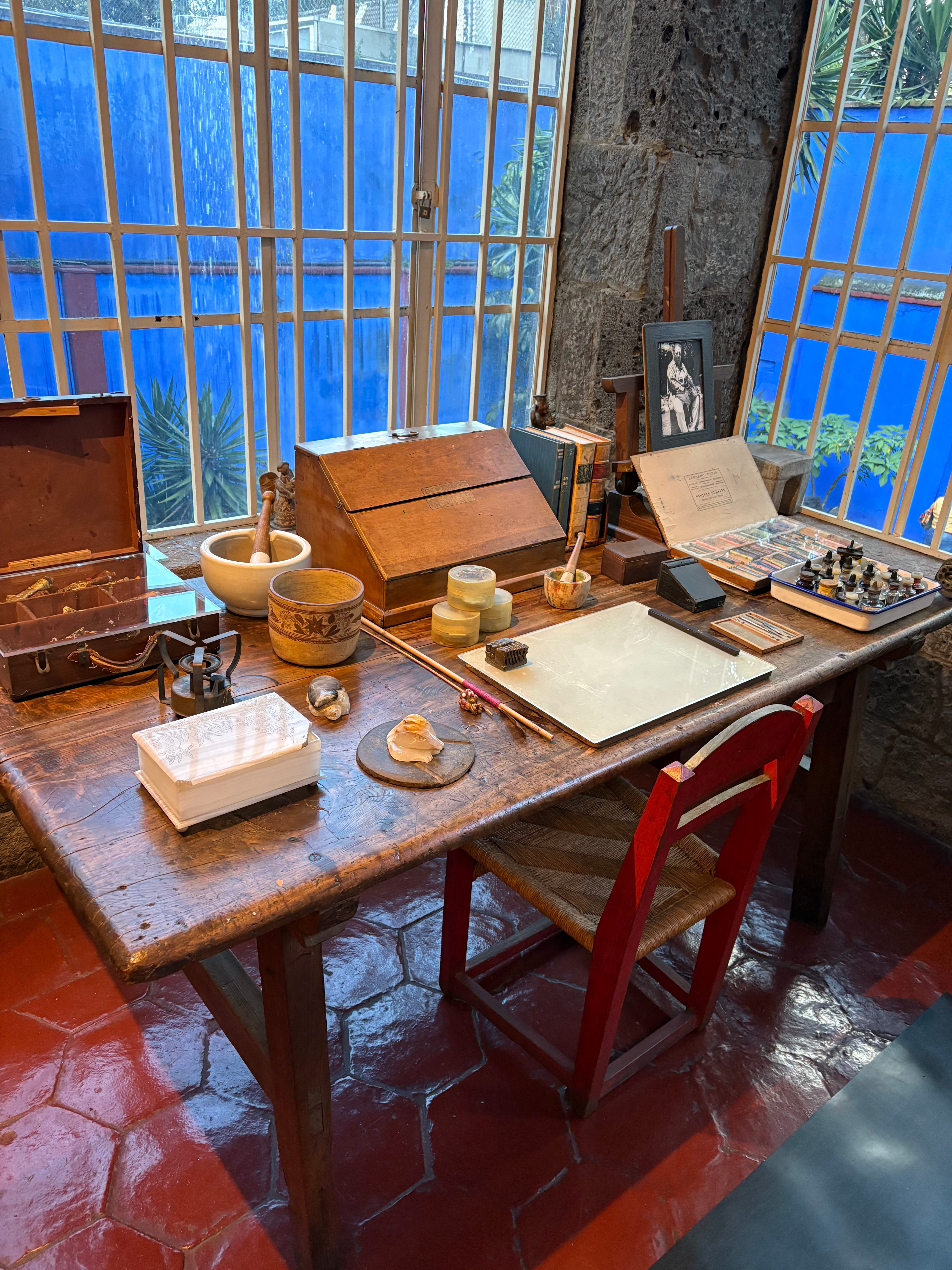
Yesterday afternoon, Virginia and I paid our first visit to Frida Kahlo’s Casa Azul in Coyoacán. Every room carried the sound of her life: her paintbrushes still in jars, her corsets displayed like armor, her bed with the mirror above it so she could paint when her body refused to move. It felt less like a museum and more like exactly what she intended it to be after her passing: a place to be reminded of your own ability to create, to overcome, to express yourself.
Like many famous artists, a word often accompanies her name; a word that was not invited but also could not be escaped from. That word is “despite”.
Despite her lack of formal training, she became one of the world’s most renowned artists.
Despite gender and sexual identity norms, she lived life on her terms.
And most of all, despite tremendous physical pain, she was a prolific creator.
Every wall, every stroke, every color was a way to stay alive inside the truth of her experience. The more her body betrayed her, the more she created. The more she suffered, the more her imagination demanded shape and form.
As I said, Frida wanted her home made into a gathering place for the world; a place that we can gather not so much to remember her, but to remember what we can do. Walking through her home, I could feel the hum of Frida’s energy in every color and texture; each awakening reminders of my soul already knows.
Amidst all of the artifacts, one particular reminder dropped into my conscious:
When you’re afraid, go create something.
Fear is energy looking for direction. When it doesn’t have one, it rots into paralysis or bitterness. But when you move it into creation, it becomes fuel.
Frida couldn’t run from her pain. Nor from the fear. She lived with a shattered spine, a leg that wouldn’t heal, and a husband whose love tore and mended her over and over. Yet her world didn’t collapse inward. She painted her body, her heartbreak, her rage, her laughter, her desire. She turned everything into image, into color, into presence. She didn’t paint to be brave; she painted because her fear demanded somewhere to go.
“I don’t paint dreams or nightmares, I paint my own reality.”
― Frida Kahlo
We might not have to deal with fear of physical suffering, but we all have to deal with existential fear; the raw awareness that we live and die, that nothing lasts, that meaning must be made. We all meet that quiet dread in the middle of the night when the noise stops and the mind starts asking, What is all this for?
The mistake is thinking the goal is to silence the fear, but fear is just a signal to pay attention. When you see that fear is an invitation to create, you enter the part of yourself that isn’t afraid to exist. Creation doesn’t erase fear; it gives you a way to channel it.
Creativity isn’t just for artists. It’s the root of human problem-solving. It is the very thing our fear is asking for but doesn’t know how to put it into words. It’s how we make the invisible visible. Using your imagination to make something real is what our species does best.
The act of creating is almost endless: writing, painting, cooking, designing, planting, repairing. You don’t need to call it art. You can call it processing, designing, expressing, or inventing. What matters is that you cross the line between thought and embodiment.
This leads to another important lesson from Frida. She organized her entire life around creating. She likely would have done that even without the physical suffering, but it became extra important because it reminded her what she had actual control over. That’s why it is essential for each of us to have a version of our own studio.
It doesn’t have to be a room with canvases and brushes. It can be a corner of your desk, a corner in your bedroom, a space in the park. What matters is that it is a sacred place to build (and protect); a place where fear meets form.
If you can’t find space outside you, build it inside you. Visualize a place where you can step away from reaction and step into making. When you do that, you give your nervous system a job it understands: to move, to form, to play.
A note for entrepreneurs:
If you’re a solo professional and are someone building a business, a brand, or a body of work, creation is also how you feed yourself. Your fear about money, relevance, or belonging is real. But fear can point you to what’s alive. Use it. Create something that meets a real need, that holds value for others, that can sustain you. Start small. Think of your idea as a minimum viable product: the smallest version of your creation that can live in the world. And go fucking sell it. It doesn’t need to be perfect. It just needs to be your fear turned into something people need.
There’s a kind of grace that lives in action. You can think your way into panic, but you can’t paint your way into despair. Once you’re moving, the fear shifts texture. It becomes heat instead of cold.
So when fear comes, don’t analyze it. Pick up a tool. Write the first line, sketch the first shape, design the first offer. Let your hands move before your mind argues.
In that sense, creating is a physical act of faith. Not belief in a higher power, but belief in the simple possibility that what you make might matter.
There’s a quiet alchemy in this. Every time you make something out of your own hands or mind, you declare that being alive is worth the trouble.
Fear is often just the body asking for movement. So move by creating something.
Make things that can hold your fear. A poem. A plan. A meal. A new business offer. A song that so cracks open the hardness fear builds around the heart.
You’ll find that as you create, the fear changes shape. It doesn’t leave. It learns to kneel before the heart. It watches you work. It remembers its place.
Every creator you admire has done this. They’ve met their own darkness with motion. They didn’t wait for courage; they built it by making.
When your response to fear is to create, you reclaim your agency. You stop being a witness to your own anxiety and become the author of your experience.
Creation is how the human spirit metabolizes terror into beauty. That’s why every culture tells stories, carves symbols, sings to the sky.
A final lesson Frida reminded me of:
Frida painted flowers because she knew they would die. She painted the truth of everything we love: it ends. Each petal was defiance. Each petal was devotion. That’s the work. To make something beautiful inside what is dying. To create anyway.
So I will say it again:
When you’re afraid, go create something.
Let your hands prove to your heart that life is still happening.
Creation is how you stay in the conversation with existence.
And if you need a place to begin, start with what’s right in front of you: the feeling in your chest, the mess on your desk, the question that won’t leave you alone.
Build your studio around that.
Build your world around that.
And the world, even broken as it is, still needs what only you can make.
Excellent brother!