
The Music Beyond the Static

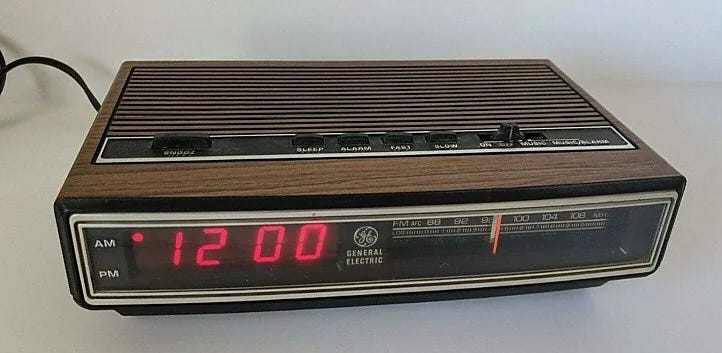
I grew up in rural Oregon in the 70s. We didn’t have a TV in our home, so AM radio was my only “streaming platform”. It was a constant battle between static and stream. On some nights in my bed with my radio pressed to my ear (headphones weren’t a thing yet), I could pick up stations in LA or Denver. Other times, a cloudy day could fill the tinny speakers with static, even for the shitty little radio station we had in Baker City.
Fast forward 45+ years…
One of the goals for moving to Mexico last June was to simplify; to create the space so that the life I want to live could emerge. I’ve defined that as living a life full of joy, abundance, and adventure. All three feel distant these past few months. Life keeps getting in the way of plans. I am tired, over-stimulated, and disoriented. I loath complaining and a lack of gratitude, but most days I manage the life I intended instead of living it. Some days, I hear the music, but most days have been full of static.
The strange part: I have been productive through all of it. By every productivity metric, this year counts as a success. But somewhere in the checking of the boxes, I noticed what the productivity was doing. It gave me somewhere to hide. In some ways, every finished task reminded me that I was not getting closer to joy, abundance, and adventure. Productivity had become a respectable form of drift.
To understand how to navigate all this, I returned to a framework that I have used with my clients:
Awareness — name what I am feeling and experiencing, with brutal honesty
Acceptance — separate what is true from what is existential
Assess — take inventory of the resources available right now
Act — do the right things, even if they seem small
Adjust — evaluate what the prior four steps revealed, then begin the circle again
The sequence is a circle that is similar to what they teach in survival training. If you watch an episode of “Alone” you will notice all five. Survival training works. It keeps people alive in conditions designed to kill them. But the fact that my framework is related to surviving is part of the problem. Survival mode narrows a person down to threat and necessity. It has no room for joy, no use for abundance, and no patience for adventure.
The Static Point
That realization led to the thesis for this essay:
Chronic stress, instability, nervous system disruption, and a VUCAH world (volatility, uncertainty, complexity, ambiguity, and hyperconnectedness) have blurred the line between a genuine crisis and an existential crisis.
I call this the Static Point.
The Static Point is when all of those factors combine to create static: interference dense enough that you feel disconnected from your soul, your purpose, your Higher Self while also not having the stability the ego and the nervous system crave. In this state, faith that things will get better can easily become spiritual bypassing, where even believing in the soul is just a form of escapism.
A healthy nervous system can tell the difference between a real crisis and existential one; discern between static and music. However, chronic stress and instability degrades that discernment. When uncertainty never resolves; when the conditions stay volatile, ambiguous, and hyperconnected for months on end, the brain starts treating not-knowing itself as danger, releasing the same stress hormones about an existential crisis as it does for a concrete threat. A genuine crisis at least offers something to act on, but an existential crisis offers nothing but static. This is the Static Point: a threat system activated in permanent “on” mode so that “what is my purpose?” and “what is that noise?” become the same question, which drowns out the music of the soul.
Some nervous systems experience this more intensely. Autistic and ADHD brains tolerate less uncertainty, take in the world at higher sensory intensity, and produce stress responses that build faster and subside slower. For a neurodivergent person, a chronically unstable environment can register as one continuous crisis, even when no single threat exists to point at.
I am living inside that research. This year, I began uncovering autistic traits I had never realized before, especially related to noise sensitivity. In the US, familiar surroundings and familiar routines masked this. Here, nothing is familiar enough to mask anything. The constant stimulation of this city presses on my nervous system all day, and if I do not de-stimulate before bed, I sleep like shit. The discovery changed how I read my own history: what I had called restlessness or stress for decades was, at least in part, a nervous system taking in more than it could process.
Underneath the sensory noise sits the existential kind: the feeling of being displaced. While it is true that my soul does feel more at home here, I am still a foreigner learning a culture, a language, a way of living that is starkly different than the US. I chose this life and I still choose it, and some days it is the most courageous thing I have ever done, and some days I am a man standing in a foreign country wondering what the hell I’m trying to prove. Now add a deadline: for a variety of reasons, Virginia, Andre, and I have to be out of our apartment by the end of July. This is a good move but still adds to the overwhelm: a genuine logistical problem, an existential ache, and an overstimulated nervous system, all at once. That combination is also the Static Point.
Symptoms of the Static Point
I know the symptoms because I have lived each one:
You stop trusting your soul. Control replaces trust: over-planning, ego-based hope, the attempt to manufacture certainty through effort.
Relief becomes the high point. You stop expecting joy. A day when nothing goes wrong counts as a good day, and you never notice the moment you accepted the downgrade.
Impatience and frustration. They show up in your mood, your mindset, your work, your relationships.
Comparison with others, creating resentment. From inside the static, everyone else seems to hear their music just fine. First you resent them for it. Then you resent yourself for the resentment.
Shame. Mine has a specific sting: I should know this shit. Yet I still have spent months unable to hear past the noise.
Catastrophizing or romanticism. FML (fuck my life) or “Some Day When.” One declares the present is the future. The other postpones living until conditions improve. Both are drama queens.
How to Find the Music Again
The music is different for each person. Mine is the life I named at the top: joyful, abundant in all the ways, adventurous. Only you can recognize yours.
I also know that the way back to the music cannot be reached through spiritual bypassing. Forcing gratitude over unfelt grief produces more static and adds dishonesty to it. The way back is “both and”.
Gratitude and grief. Compassion and anger. Faith and doubt. Hope and “this fucking sucks”.
Acceptance of “both and” allows for discernment between static and music. When two true things can coexist, you can finally tell them apart. The dread about the apartment search is static, an alarm from ancient circuitry with no predator attached. The desire for a home where we can build the next chapter is music. The fear of never belonging anywhere is static. The love underneath that fear, the love that made me leave everything familiar in the first place, is music.
This discernment then points us toward our center. Thomas Merton wrote:
“At the center of our being is a point of nothingness which is untouched by sin and by illusion, a point of pure truth... It is like a pure diamond, blazing with the invisible light of heaven.”
Static interferes with your perception of that point. It never touches the point itself. Nor does our center ever produce static.
How we return to center is personal and unique, but here are a few possibilities:
Creating — writing, painting, cooking, building, composing. The medium matters less than the act. When you make something that didn’t exist before, attention shifts to the present moment, and you can hear the music. Ego cannot make and react at the same time.
Eroticism — full-bodied presence with another person: skin, breath, eye contact, desire. Static quiets because the body and the soul become one, and for a while there is no sense of time, no current worry and no future state.
Serving others — Acts of kindness makes your attention shift from your own noise to another person’s need, and the shift is a reminder of what to prioritize.
Solitude — time alone with no inputs. Deprived of new material, the noise exhausts itself, and what remains underneath is music.
Centering prayer — a contemplative practice developed in the 1970s by Trappist monks, drawing on The Cloud of Unknowing and the desert tradition. You sit in silence for twenty minutes with a short sacred word and each time thoughts pull you away, you return to the word. This practice reminds our minds that they work for our souls.
As I said, we each have to define our music, and our own path through the static back to the music. But each of these have served me well in the past few days.
A Mantra
Here is the hard truth about finding the music: once in crisis mode, our mind wants none of the practices I mentioned. If it can’t have distraction, it wants resolution, solidity, and certitude - and it wants them today. Which is why this mantra has been on tongue and mind many times a day recently: low expectations, high standards.
The mantra applies to every situation, but the apartment search is where I practice it the most. Low expectations: the search will take longer than we want, the listings will disappoint, and my nervous system will spike more than once before August. High standards: we will choose a home that serves the life Virginia and I came here to build, with enough quiet for how I am wired. Low expectations keep the survival circuitry from declaring an emergency. High standards keep the soul in charge of the decision.
"There is something in every one of you that waits and listens for the sound of the genuine in yourself. It is the only true guide you will ever have. And if you cannot hear it, you will all of your life spend your days on the ends of strings that somebody else pulls."
- Howard Thurman
The temptation is to treat the static as reality and the music as wishful thinking, because the static comes with evidence: the deadline, the noise, the nervous system firing all day. But evidence is not the same as primacy. The music holds an equal claim on what is real, and it plays whether or not the conditions permit me to hear it. So the practice cannot be waiting for the static to end, since in a VUCAH world it never will. The practice is tuning toward the music while the static goes on. Whoever waits for better conditions has already let the conditions choose for him. I intend to choose. Joy, abundance, and adventure, regardless of the conditions.
Moved from Napa to France just over a year ago … spot on (and brilliant)! It’s especially hard to allow for the struggle that holds the growth you need when surrounded by what appears to be paradise…
What a beautiful gift, Justin. Your candor makes me smile deeply.