

Charlie Kirk’s murder broke something in me. Not because of who he was, but because of what the response laid bare. A man was shot, and instead of call to unity, instead of reverence, the country reached for its drug of choice. His death became performance, each side rushing to carve their piece from the body.
The Right lifted him up as if death itself had anointed him a prophet.
The Left smirked and muttered that he had invited it, that words justified bullets.
The Right scrambled to cast blame on queer communities, feeding the fantasy of persecution.
The Left chuckled that the alleged killer came from a conservative family, as if ancestry explained anything but our shared sickness.
The Right shed tears for their chosen martyr while ignoring the bodies of Melissa Hortman and her husband, and the countless lives erased by gunfire in schools, in grocery stores, in neighborhoods across the country.
What this revealed is more than politics. It is a collective conscience corroded by addiction. It is the proof that identity tied to ideology is the most hollow form of selfhood. It is the evidence that empathy, critical thought, and moral clarity have been replaced by theater.
A man’s death should never be another way to score points. Words should never demand blood. Yet here we are, a culture that cannot stop turning bodies into trophies for its tribal war.
The Epiphany
The next day, I sat in a café in Colonia Del Valle steeped in grief and despair. The air was thick with the smell of roasted beans and sweet bread. The hiss of the espresso machine broke through bursts of Spanish conversation. Vendors called out through the open door, selling tamales and papers. I could hear children playing in the school across the street, while horns blared from passing cars. The city hummed in its own key.
I sat still, hands wrapped around the mug, and the warmth burned instead of comforted. I was grieving, not the man in the headlines, but the country itself. I watched the steam rise from that cup of coffee, my journal open and filled with a jumble of words. Then I realized something I had avoided naming. Leaving the United States was not a change of geography. It was ending a relationship with someone who cannot stop destroying themselves.
Addiction Wears a Flag
The United States is an addict. The substance is ideology. It is not politics as governance or politics as a means of solving problems. It is politics as narcotic, used to numb the fear of meaninglessness and to create belonging through division.
Like any addict, the country follows the cycle. Denial: “This is strength. This is freedom. This is who we are.” Escalation: yesterday’s rush will not do, so today demands more rage, harsher villains, blood if necessary. Withdrawal: the shaking emptiness when outrage fades, the gnawing hunger for another hit.
Addiction devours everything in its path. Families split open. Communities fracture. Empathy disappears. People stop describing themselves by what they create or love or serve. They describe themselves by political identity, as if a slogan could carry the weight of a soul.
This addiction does not hide in shame. It wears the flag like a badge of honor. It calls itself holy. And in doing so, it makes healing nearly impossible.
Toxic Empathy
To be in a relationship with an addict is to live in cycles. A good day followed by a collapse. A promise followed by a relapse. A brief tenderness followed by a strike of cruelty. Every addict carries two selves. The one you first fell in love with, and the one who cannot put down the bottle, the pipe, the needle.
The U.S. has both. I remember the self I loved: the dream of freedom, the courage of its builders, the hope that conscience could shape history. That was the self that drew me in. But the self I live with now is the addict: grasping for ideology, raging with cruelty, willing to kill its own children for another fix of identity.
I catch myself whispering the words every codependent knows. I love him but …
I love him but he keeps putting guns in children’s hands.
I love him but he mistakes rage for courage.
I love him but he is burning down his own house.
These words are not hope. They are the grammar of codependency. They are the way a person excuses violence because the memory of tenderness still glows. They are how one stays bound to an addict, even when every sign says it is time to walk away.
Debate as Intervention
For years, debate was my way of trying to intervene. I treated it like sitting across from the addict, looking him in the eye, and pleading with reason. I believed that if I could bring enough clarity, if I could expose contradictions, if I could press the truth hard enough, something in him would shift. Debate became my version of pouring out the bottles and hiding the keys.
But the reality is different. Most who show up for debate are not seeking clarity. They come high on ideology, already intoxicated by their tribe. Their words are slurred with certainty. Their eyes are glassy with delusion. Their hearts are closed. To engage with that is not debate. It is theater. And theater is not worth my time, my energy, or my spirit.
Debate, when practiced with integrity, is for enlightenment. It sharpens thought. It clears away falsehood. It cultivates humility. But debate requires partners who can feel and think at the same time. Empathy and critical thinking are the ground on which real dialogue stands. Without those, words collapse into noise.
I love debate. I love the fire of it, the art of ideas sparking against one another, the way it can open a window to something larger than either voice alone. But I will not debate anyone who treats it as entertainment. I will not waste myself on arguments with people who refuse to imagine another’s pain or examine their own beliefs. To do so costs more than it gives.
So the rule is simple now. I am open to debate with anyone who brings empathy and practices critical thinking. That is the only ground I will stand on. Anything else is a shouting match with a drunk, and I have already walked out of that house.
The Anatomy of Codependency
Codependency is not a weakness. It is survival learned in toxic intimacy. You learn to read every twitch of the addict’s face. You learn to anticipate moods. You learn to manage chaos, to clean up the bottles, to hide the evidence. You learn to carry hope like a shield. You convince yourself that love will be enough.
But love is never enough for someone who refuses to heal.
The addict becomes the center of your universe. Their needs become your compass. Their destruction becomes your weather. You lose track of where they end and you begin. Every thought bends toward saving them, or at least containing the damage. Every prayer is for the return of the person you first loved.
The cost is staggering. It drains your body. It wears down your spirit. It teaches you to betray yourself in the name of loyalty. You lose sight of your own worth, because you are always calculating theirs. You live in vigilance, always scanning the horizon for the next collapse, always rehearsing what you will do when it comes. The addiction reshapes you until your own identity is entangled with their sickness.
That is what it feels like to still be bound to the United States. I carry the news like bruises. I lose sleep. I watch from afar as the cycle repeats and repeats. I tell myself, maybe one day he will remember who he was. Maybe one day the promises will mean something again. That hope is the hook. That hope is what keeps me tethered.
The Grief of Real Leaving
Geography is tedious but easy. Packing boxes, signing leases, booking flights. Those are logistics. Real leaving is harder. Real leaving is sitting in a café in a foreign city and realizing that you cannot save the person you once loved.
I cannot make him put down ideology.
I cannot force him to see the bodies piling up.
I cannot reach into his chest and restart his empathy.
I cannot change him.
That truth wrecked me. It left me staring at my coffee, unable to taste anything but ash. Because I realized I had been bargaining. I had been waiting for him to get better, to return to the self I once loved. But the man across from me is not that man anymore. He is gone, and the addict has taken his place.
The Cost of Staying Tethered
Every addict teaches their partner the same lesson: you can love them or you can save yourself, but you cannot do both. Staying tethered means living in constant crisis. It means your nervous system never rests. It means carrying grief like a permanent stone in your chest.
That is what my tie to the U.S. has become. Every headline pulls me back into his chaos. Every new shooting is another broken promise. Every smug reaction is another cruel relapse. And the cost is my own peace, my own presence, my own ability to live fully in the life I am building here.
Yet I still grieve. Not out of allegiance to empire or loyalty to ideology. I grieve for the people. The children who deserve more than to be pawns in a performance. The families who deserve mourning instead of mockery. The lives wasted while both sides sharpen their tongues.
The Hardest Goodbye
To truly leave, I must stop asking the question that still haunts me. I must stop asking where the shame is. Asking means I still expect an answer. Expecting an answer means I am still waiting for the addict to change.
This city is not a rebound. It is not here to heal me by distraction or to play the role of replacement lover. Its streets, its music, its people do not exist to erase what I left behind. They simply live, and in their living I am reminded that love can take other forms. Mexico City is the backdrop for my grief, not the cure for it.
I whisper a prayer. Not for reconciliation or repair, but for release. For the strength to cut the tether. For the courage to love without expectation.
Because I cannot fix him. I cannot change him. I cannot make him choose life.
Until I accept that truth, I will carry the grief like a stone in my chest. A reminder of what once was beautiful. A witness to what became broken. And a vow that my life, here and now, will not be governed by the sickness of an addict I finally had to walk away from.
The Soul Does Not Need a System
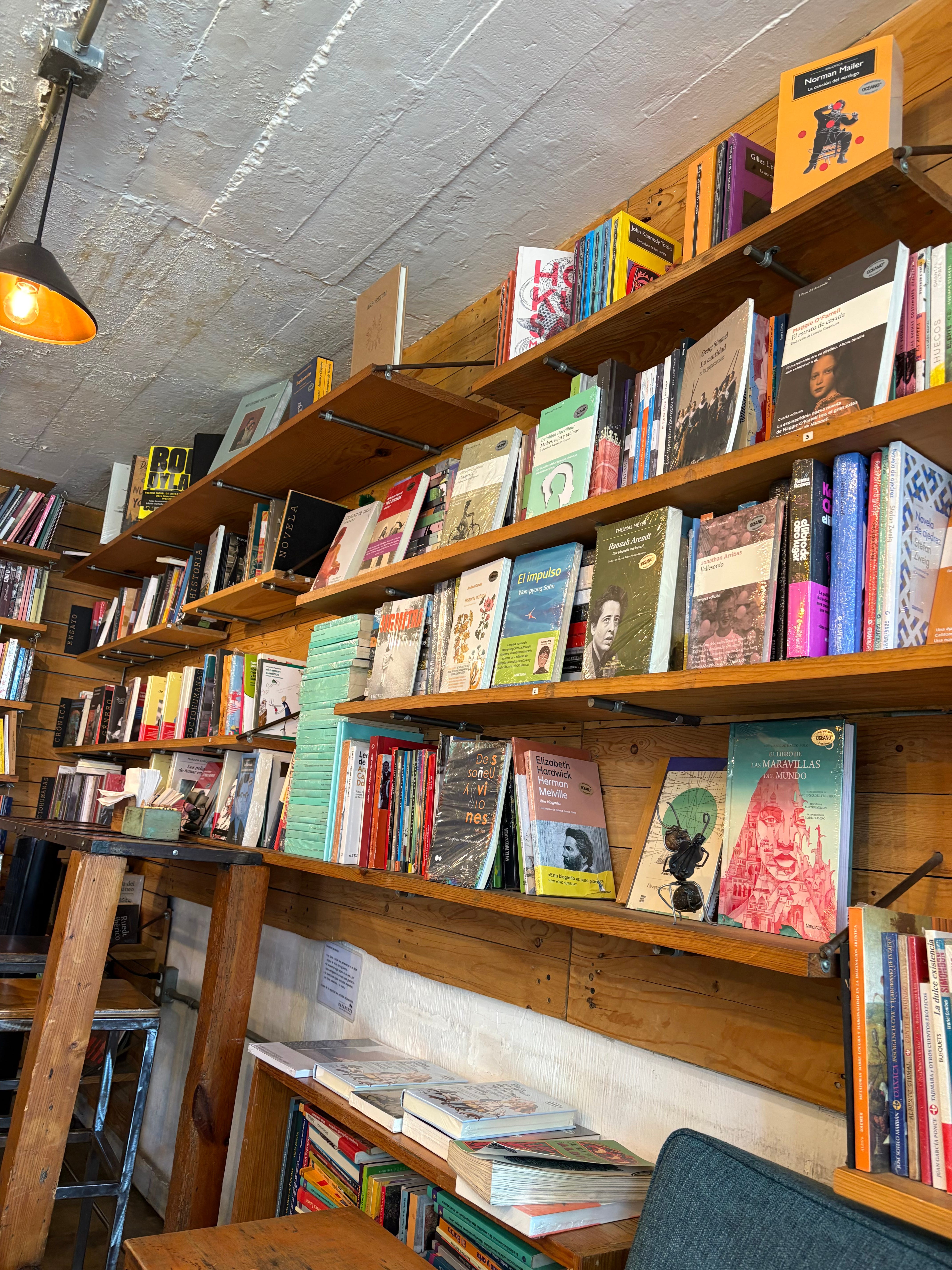
Today, I went for a very long walk and ended up in a café that was also a bookshop (pictured above). Along the walls were shelves of books I had already read in English: Thomas Merton, Simone Weil, Paulo Coelho, Rumi, Octavio Paz, even a well-worn copy of Meditations by Marcus Aurelius. But here they were in Spanish. Their presence stopped me. I knew the words, I knew the truths they carried, yet here they stood in another language, alive in a form both foreign and familiar.
It was then I had a second and much more hopeful epiphany: the soul does not need a system.
Those books were written in two languages: one I am still learning, but also the deeper language of timeless wisdom. Wisdom, an extension of the soul, does not rely on systems, translations, or ideologies to recognize truth. It does not require scaffolding to stand whole. It belongs to something more ancient than parties, more enduring than nations, more spacious than any institution. The soul carries its own grammar of honesty, courage, love, and connection.
Systems can order the outer world, but the soul thrives in presence. It speaks through silence as easily as through words. It remembers what matters without needing doctrine. It creates belonging without demanding identity.
The addict I left behind clings to systems as if they were lifelines: political identity, culture war, power as performance; clinging to each like a needle that never satisfies. But in that café, surrounded by the voices of mystics and philosophers written in a tongue not my own, I saw clearly: the soul drinks from a deeper well.
This is the truth that allows me to walk away. The soul does not need a system. The soul is already free.
I understand this. I lived abroad for 15 years in several countries, two of which were not English speaking. I know that life is possible and rewarding. But for many of us - because of age or means - it's no longer an option. So we remain and deal with what feels like a permanent chronic illness.
As I read your post, I also thought of the vast number of people in the middle like me for whom the polarization has not taken hold in our lives. We are focused on other things like making life work each day and helping others. We just don't make as much noise, but we are here.
I also know from living abroad that no matter how fully one assimilates into their adopted culture, there is never quite the same sense of belonging that one has in their own country. The roots are too deep. The cultural subtleties that we learn as children and hone as we grow.
I get all the reasons for moving. I just hope people who take this step realize that to find peace and happiness, it's not just about leaving a toxic relationship. We take ourselves and all our angst with us. And social/political upheaval and change happen everywhere. No one ever expected our nation to be so dysfunctional, to slide into depravity so quickly even though the signs have been there for a long time. The truth is, it can happen anywhere.
Thank you for sharing what is on your heart. As a former alcoholic, I can now understand what I did to those who love me as I continued to feed my addiction day after day. For years, I would black out each night, but had no clue. I would wake up thinking I just slept hard and would repeat what I did the day before. It is only in recovery did I finally learn the truth about my blackouts and the damage I caused up to the moment of blackout.
May we see the day the collective culture of the United States hit bottom so recovery can begin.