

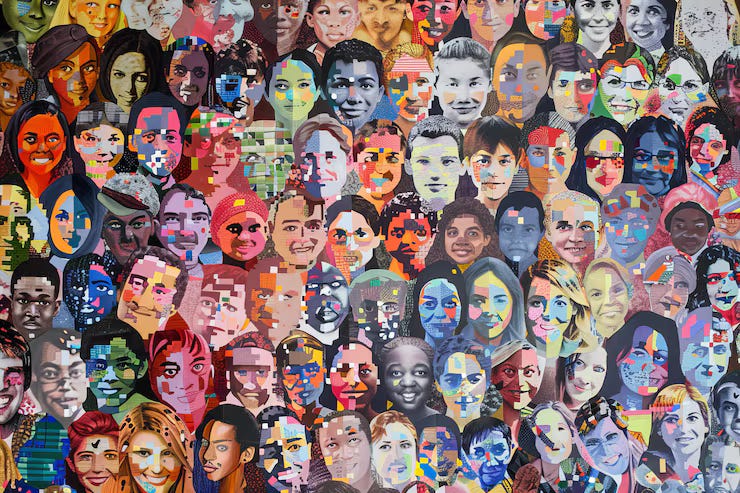
I pay attention to faces.
I scan, make eye contact, and notice the mosaic details.
Some of this is a natural-born vigilance common with those of us with ADHD. But it is also an insatiable curiosity about humans. And faces tell a story far more than style, age, ethnicity, etc.
Most faces are quickly forgotten. But some stand out so obviously that they are etched in my mind. I have told Virginia that if I didn’t know her and I saw her face in a crowd of people, I would know that she is my person.
But that’s not what this essay is about. This essay about some three other faces I have never forgotten; faces that helped me define the kind of life I want to have. Or as you will see, the kind of life I DID NOT want to have. In only one of the cases did I talk to the person, and that was only briefly.
The first face was in the Buffalo airport in 2003. I was on a business trip for the company I worked for; my last W2 corporate gig. I was the VP of Sales for a small B2B software company that was owned by a multi-billion dollar company. After years of financial struggles and instability, I had a six-figure salary, good benefits, a company credit card, and I was able to do one of my favorite things: travel.
It was around 10pm on a Friday night and I was catching a flight back home to Boise, Idaho. I noticed a man who reminded me of Dick Cheney (another potentially annoying habit: matching faces with famous people). He was in an ill-fitting suit; out of shape with an unhealthy pallor. Like Dick Cheney, he had a face that always seemed to be “old” but I’m going to guess he was in his 50s. Everything about him was grey; his suit, his thinning comb-over, his energy. He was pulling one of those catalog cases on wheels. The kind you would see for someone who is selling wholesale plumbing supplies. He was walking as if he was pulling it across a desert. Slumped over, sweat on his brow, looking haggard and weary.
I remember thinking, “that could be me in 25 years.” I worked for a very established company who was known for the tenure of many employees; some over 45 years of working there. I was good at my job, driven, and grateful for the stability. I returned home, but his face stayed with me. “I don’t want to become him” looped in my consciousness. I began to explore different entrepreneurial ideas - from franchising, to joining a start-up, to contracting work. About three months after that trip, we learned that the holding company had sold the subsidiary to another big company. I was offered either a 6-month severance package or to take a similar role in their Baltimore office. I thought of that man, chose the severance package, and with several other guys from the same company, started a B2B marketing agency.
The second face of the future was an Uber driver in LA in 2012. I enjoy talking with people that others often look past so I tend to strike up a conversation with an Uber driver if the energy feels right. They frequently have fascinating stories and other side hustles. I could easily write an entire book on stories from Uber drivers. This Uber driver’s name was David.In his reflection in the rearview mirror, I saw the lines of a much older man, as well as a pronounced scar on his cheek. When we made eye contact, I saw a combination of defiance, humbleness, and grief. Back then I had no idea who Hunter Biden was but when I see him now, he reminds me of David. After the standard back and forth, I said to him “I sense that you have a lot of stories in you.” He then told me his story.
Like Hunter, he also had a famous father. I do not recall David’s last name or his father’s name, but I remember looking it up later to confirm some of the story. His father was one of the most successful real estate developers in Southern California - worth billions of dollars. He also backed some successful studio projects. David had access to the best of everything: private school, vacations in exotic places, etc. David went film school at USC with the idea that he would be a big time Hollywood producer, backed by his father. But he had developed a severe drug addiction that had been able to keep a secret until he went to college, where the environment and the pressure brought it to head.
His father cut him off. Then he got kicked out of school. Then he was arrested and convicted for breaking-and-entering. With a criminal record, he was not able to get a job. He had no practical skills, and was too thin and slight to do blue collar work, even if he could have passed the mandatory drug tests. He spent much of the next five years in and out of rehab, frequently homeless, drifting across the country. He did not share how it happened but said he had been sober for two years and met his current roommate in a sober living facility. His roommate had a decent car, so David used it during the day for Uber and his roommate used it at night driving for Dominoes. I asked him if he had any plans. He laughed in a dark way and said “Stay clean.”
I was in a very dark place myself at that time, with some destructive habits. David had shared that going to therapy helped him understand how much anger he had towards his father. He told me that his therapist said that forgiveness was directly related to sobriety. At that time, I had never been to therapy but I was aware of a vast and deep anger towards both of my parents. The look in eyes and his words sparked something in me. After I got to my hotel, I did a search for a therapist who specialized in childhood trauma and addictive behaviors. I booked the appointment and a few days after I returned home, I had my first ever therapy session.
The last face was actually from an ESPN documentary about Bill Parcells, the Superbowl winning football coach who had retired in 2007. I believe the documentary came out in 2018 but I didn’t see it until 2020. For context, my life was radically different by then. I had moved to Austin, started a new branding agency with my business partner at the time, had a spiritual awakening, and left organized religion. I was probably at the height of my discipline related to working out, meditating, self-improvement, etc. But beneath the excitement of living in Austin, the “maxxing”, and the client projects, was a pervasive soul-level unhappiness.
In the documentary, Parcells was asked why he decided to retire. I can’t find the exact quote, but he said something like this:
“Winning was a relief. And the losses lasted all week.”
If you know about Parcells, he was arrogant, loud, funny, bombastic, larger than life. But when he made that statement, you saw none of that. His eyes and face were soft and humble, his voice almost a whisper. He then said something like “If you don’t love this game, it will hate you back.”
That interview gave my unhappiness a framework. I was starting to hate the “game”. I was doing many things right, but none of it brought me joy. I specifically remember closing one of the largest deals ever for a client project and feeling miserable about the work. I also was starting to hate the game of performative “consciousness”. That awareness led to a series of teutonic shifts, many of which I wrote about in “Essays from a Pandemic”.
Interestingly, I have not seen a face of the future that was a warning in many years. Instead, the faces of the future I most notice now are often positive and/or hopeful. The faces of the people I love and would die for. I could stare at Virginia’s face for hours. The faces of my sons and their partners. And oh the sweet faces of my grandchildren. But also the faces of persistent defiance against oppression. The faces of overcoming. The faces that radiate an inner light that can not be manufactured.
And my own face. A few lines around my eye and an almost fully white beard, but still the face of a younger man. Still the eyes of a fighter, a thinker, a survivor, but also the eyes that are quick to fill with tears of gratitude.
You have such a way with words. Loved your “stories” and how you shared them! Thanks again!
Justin, I love this post because I too study faces and remember the unusual ones and what they signify to me. There is a saying, but I can’t remember where or when I heard it: The face you have after 40 is the face you’ve earned. I think there is truth in that because by 40 you have lived enough so that how and what you’ve lived begins to show in your face. I can look at a face and determine whether that person is calm or agitated or angry etc. A face I will never forget is that of Hahn, my Vietnamese interpreter, just after I arrived at my new assignment at a Brigade infantry unit in the Mekong Delta. He seemed too tall for a Vietnamese. He was lanky and his face very long and angular with long black hair atop his head, again not typically Vietnamese looking. In my mind he looked like a Vietnamese Ichabod Crane and I think his impressive height and unusual face was because he had Chinese ancestry someplace, although we never discussed it. He was standing in front of our hooch and as I arrived with my duffel slung over my shoulder he thrust out his hand, his eyes intently looking into mine and said in perfect English with only a slight accent, “I am Hanh, very easy to die here Lieutenant, I look out for you, you look out for me.” The latter starting like a question, but veering off into an affirmative statement with a slight question mark! I said that I would and I wanted to hug him, but we had just met so, so I simply held his hand that was shaking mine a bit longer and a bit firmer so he would know that I meant it. We became like brothers and trusted each other completely. I have no doubt that If the situation ever required it, both of us would have given his life for the other-both of us fighters, thinkers, survivors.