
Doubling Down

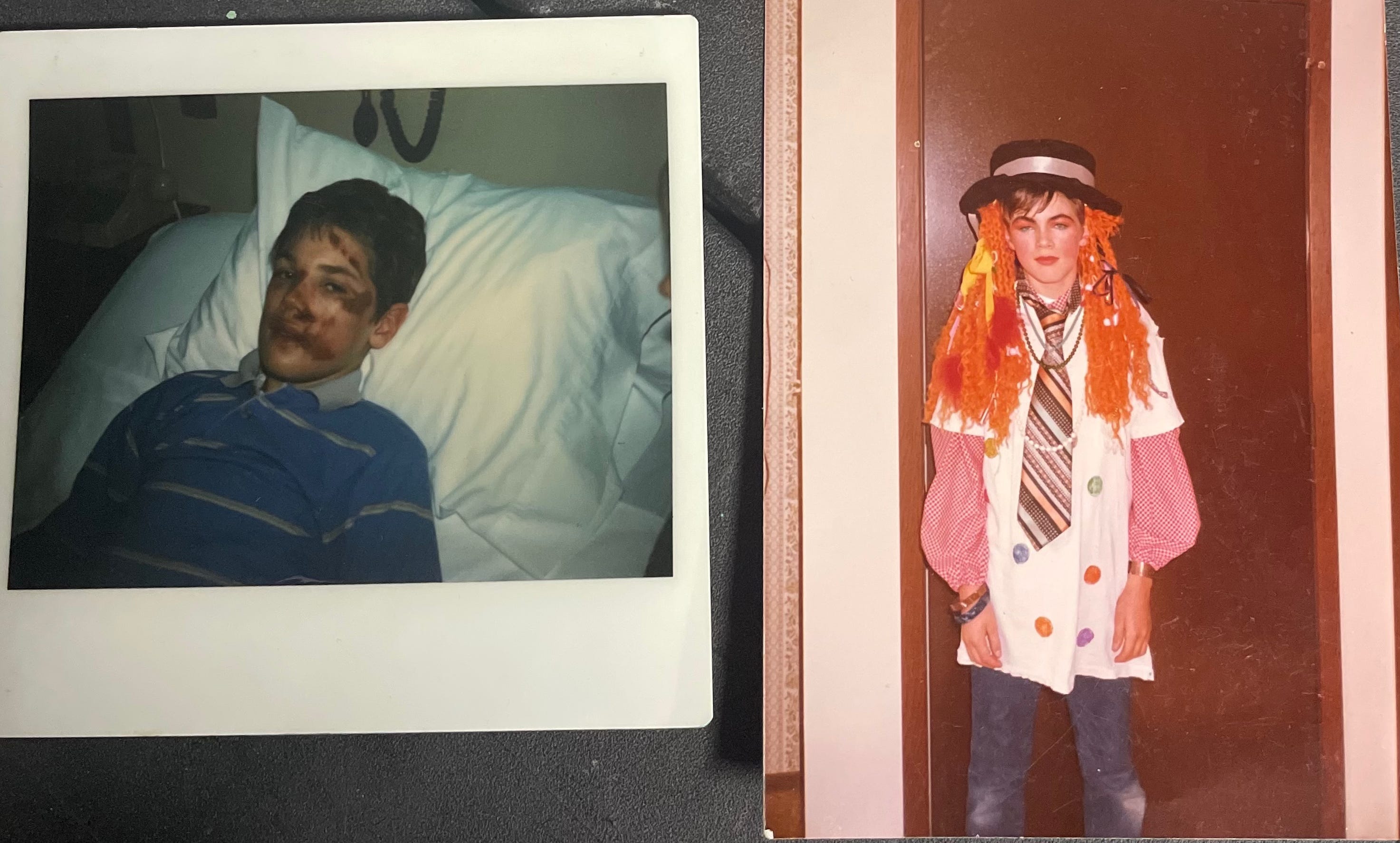
Like most families, we have several bins filled with treasures, photos, and keepsakes. Recently, my dear friend and former partner, Lynna, was going through one of the bins and came across a collage of photos of me.
I vividly remembered the circumstances of the photos, but was especially struck by how the photos represented a life-long pattern.
The picture on the left is from Easter Sunday in April, 1984.
I was 13 years old and in the 7th grade. I loved riding my Honda 125 on our ranch outside Baker City, Oregon. On that day, the snow had finally melted enough for me to go riding. I spent hours making up for those snow-bound days. Covered in mud and smiles, I decided to take a short cut back to my grandparents’ house for Easter dinner. At around 40 miles per hour, I hit a small ditch at an angle that caused me to catapult myself nearly 30 feet away. As you can see in the photo, I landed on my face; my “unbreakable” glasses carving a furrow in the ground. I was discovered an hour or so later by my uncle, who rushed me to the hospital.
I was diagnosed with a compression fracture in the T4 area between my shoulder blades; an injury I still deal with when I sit too long or get too stressed out. I also had a broken jaw and fractured my lower gum line. I spent several days in the hospital, then 6 months in a backbrace.
In direct disobedience to my mom, as soon as I could, I got back on my motorcycle. I was terrified and traumatized by the accident but something in me had to double down.
The picture on the right is about 6 months later.
As frequent readers know, I was raised in a Christian fundamentalist home, with no TV, no going to movies, and with listening to “worldly” music being strongly discouraged. One Friday night at my friend David’s house, I saw the video for Boy George and Culture Club’s “Karma Chameleon” and was fascinated by the song and by Boy George.
It is also important to note that I was a nobody; even in a small town middle school. For example, several students decided to make me a get-well card after the aforementioned motorcycle wreck. One of the messages in the card said. “I don’t know who you are but I’m sorry you got hit by a car.” I remember being both annoyed and amused.
In the fall of 1984, now in the 8th grade, I decided to double down on doing something about being unknown: I entered the 8th Grade Talent Show… as Boy George. My very strict Christian mother took me to the store to buy a copy of “People” magazine with Boy George on the cover. And then she took me to a thrift store to help put together the outfit. My mom didn’t own any makeup, so she also had to borrow or buy it. I will never forget that morning in the bathroom, my mom focused on getting my makeup just right.
I walked into school and for the first time was noticed in a (mostly) positive way. I heard kids say to each other “Who is that?!” Those of us who entered the talent show gathered behind the stage in the auditorium. Finally, it was almost my turn. With a shaking hand, I gave the cassette to the AV kid, already cued up for “Karma Cameleon”. He snapped it into the tape deck and pushed play. Instead of just lip syncing the song, I decided to do the dance from the song around the gym floor … directly in front of everyone. Talk about a double down. It was the first time I had ever heard applause for me. Out of breath, I finished the song and sat down on the bleachers next to a girl named Heather. “Who are you?” she asked with a smile. I said “I’m Justin Foster”. She said “Oh, you are the guy who got hit by the car”. I didn’t correct her and I didn’t remind her that we had been going to school together since the first grade. “That was really cool!”, she said. That was enough.
These stories are just two of thousands that have a similar pairing: fear and doubling down.
I have always been afraid, often for very good reasons. But being 55 gives you some decades to reflect on. Looking back, fear reliably appeared at moments when something in my life needed to change. It surfaced when my sense of identity no longer fit, when my voice had to be heard, when a situation had reached the point where remaining still carried its own cost. I once assumed the task was to feel confident before acting, or at least less afraid. Experience corrected that assumption. Progress came from acting anyway, not heroically, and not because fear vanished, but because allowing fear to dictate the outcome proved unsustainable. Doubling down, in that sense, had little to do with courage and much to do with deciding that fear would not be the deciding vote.
As I grew older, the nature of risk shifted, even though the underlying pattern remained familiar. Physical danger was replaced by social and economic exposure. What I risked was no longer my body but my reputation, my income, and my sense of belonging. Fear attached itself to visibility, judgment, and exclusion. The faith I inherited stopped aligning neatly with my lived experience and demanded closer examination. At each stage, fear adapted to the new terrain, but my response stayed consistent: acknowledge the fear, then double down.
Over time, this led to a quiet but important change in aim. I stopped trying to construct a life free of fear. That goal turned out to be unrealistic and, more importantly, unhelpful. Fear began to look less like an obstacle and more like a feature of the landscape, something that appears when a choice carries consequence or when something meaningful is at stake. Rather than treating fear as a problem to solve, I learned to treat it as evidence that I was engaged with the reality of my life. The work shifted from eliminating fear to paying attention while it was present, and from resistance to participation.
Seen through that lens, 2025 became another year of doubling down.
I doubled down as a business owner who speaks publicly against Trump, empire Christianity, and fascism, understanding that clarity in public life carries relational and economic consequences and choosing to accept them.
I doubled down on speaking openly about spirituality in business; challenging that they are incompatible things.
I doubled down when, Virginia, André, and I decided to move to Mexico City, trusting my intuition that it was not just time to go, but that CDMX felt like home.
I doubled down on inner work, particularly on challenging decades-old narratives that determined my relationship with money and worth.
I doubled down on mental health, especially related to more deeply understanding my nervous system.
In each case, the doubling down was in response to looming fear. But with more wisdom, doubling down was far less an act of rebellion and far more an act of faith.
But if I’m being honest, I find myself wanting less doubling down in 2026. Doubling down takes a lot of energy and internal resourcing. Instead of doubling down, this phrase has been circulating in my mind for weeks now: Source it, don’t force it.
I really hope that is true.
At the same time, I remain realistic about how my life tends to unfold. Challenges will continue to appear. Some will arise directly from choices I make with intention. Others will arrive without warning, decided by forces already in motion and indifferent to my preferences. In those moments, the question rarely concerns comfort or certainty. It concerns taking ownership over my choices, my resources, and my energy. It makes taking responsibility for the situations I am in and for the consequences that follow. So although I hope for more flow and less fear, I also know what to do either way…
Double down.
Sometimes we just have to grow up to figure a few things out.