

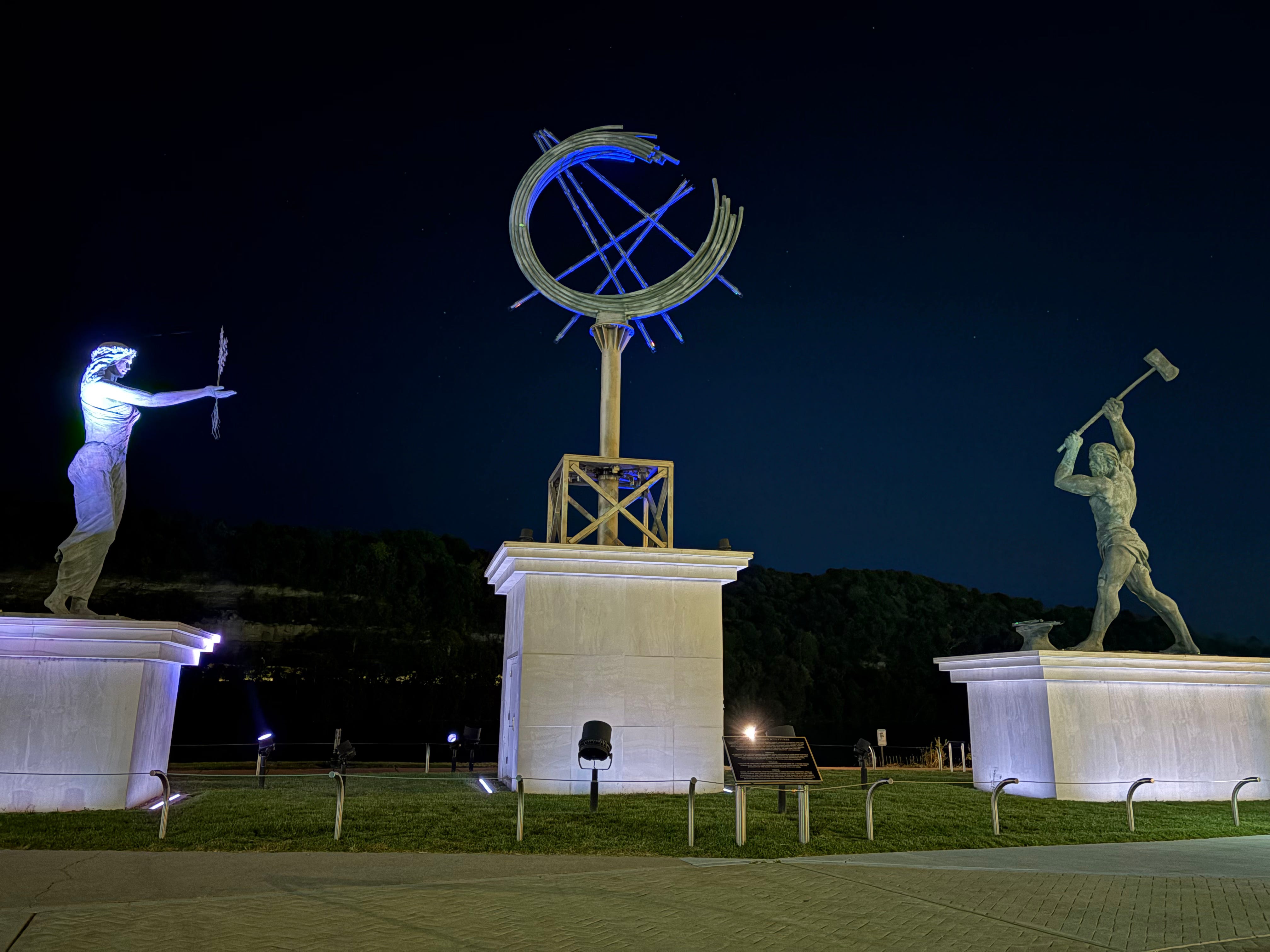
Yesterday, I spent most of the day on the campus of Ohio University in Athens, Ohio. The trees glowed with the optimism of youth, the sense that this generation, polite and diligent, could bend the arc of history. Only a short drive away stood the all too familiar story of the towns of Appalachia, where churches marked every corner and hope had thinned into endurance and bitterness.
Last night, we stayed in Ashland, Kentucky, a town I had never heard of that carries its own quiet renewal: art along the riverwalk, music spilling from storefronts, small shops reclaiming the bones of a dead industry. The country reveals itself that way—despair braided with rebirth, exhaustion breathing beside possibility.
These scenes, thousands of miles away from our new home in Mexico City, made me reflect on the idea of patriotism; a word distorted by both promise and denial, a word recited by memory more than by meaning. This subject has been rising inside me for months, stirring the same unease that always comes before the end of an illusion. When something inherited begins to crumble, I know it is time to face it. For me, deconstructing my patriotism is spiritual inventory, a long stare into the stories that shaped me, an effort to uncover what remains true when every borrowed certainty fades.
Every few years, life asks me to dismantle another structure that once defined me. Faith yielded first, then marriage, then work, and each collapse revealed a deeper layer of freedom. The pattern is familiar now: discomfort begins, a question forms, and eventually the truth demands attention. The newest question centers on my country, the place that raised me and shaped my moral vocabulary. What does it mean to love a nation whose virtues and violences intertwine? What kind of belonging honors both history and conscience?
For those raised in a high-control religion, the idea of deconstruction feels familiar. For others, it may need a brief explanation. Deconstruction is the slow and deliberate act of removing illusion from identity. It is the practice of asking what is essential once the scaffolding of certainty gives way. It does not destroy belief; it exposes its foundations. It is a form of spiritual clarity that separates truth from inheritance, a philosophical and moral excavation that brings consciousness closer to what is. In its truest sense, deconstruction is a sacrament of awakening, an unbuilding that reveals the architecture of freedom underneath the architecture of control. It requires courage, because every false story resists its own unraveling. It requires tenderness, because what collapses often feels like self-loss. And it requires integrity, because once you see through illusion, you can never unsee it. Deconstruction has been the central discipline of my adult life, the through-line in every transformation; a discipline essential to liberation in every form.
When I reflect on the deconstruction of my faith, I see the same pattern that now moves inside my relationship to America. I once worshiped an image of God that demanded submission and rewarded purity. That God thrived on fear, hierarchy, and proof of loyalty. My prior idea of America carried the same energy; a sanctified myth of exceptional goodness, guarded by those who feared its examination. For years I served both myths. I said the prayers, I stood for the anthem, I defended the stories that defended me, until the call of truth became stronger than comfort.
Rigid faith yielded to revelation. The God I had known was too small to contain love that vast. When the scaffolding of doctrine dissolved, I met something unbound and luminous, a presence that asked for nothing and welcomed everything. I call that Christ consciousness, though the name only points toward what words cannot hold. That awakening became the first liberation, the recognition that holiness lives in honesty.
Marriage followed. It began in devotion and ended in grace. Love had always been present, yet it had grown inside walls built by tradition and duty. Over time, silence revealed what language had concealed. When the end came, it came as release rather than rupture. Lynna and I stepped out of the expectations that had framed us, each reclaiming our wholeness. That moment remains sacred to me because it showed that love, when purified by truth, becomes a liberating force.
Then my career transformed. For years I sold strategies that polished illusions. I helped people say what others wanted to hear, and I mastered that art until it lost its meaning. Gradually, I began to ask what branding might become if it spoke truth instead of control. The question dismantled everything I had built and led to Massive, to the belief that branding can serve liberation rather than manipulation. That shift became another act of freedom, one that turned work into conscience.
“I love America more than any other country in the world and, exactly for this reason, I insist on the right to criticize her perpetually.”
― James Baldwin
Now patriotism stands before me as the next threshold. Every deconstruction removes an identity the system assigned to me and restores the self that existed before it. Each time the question is the same: Who am I beyond this structure? What beliefs did loyalty create in me? What remains when power no longer defines belonging? Patriotism carries its own weight because it has rewarded me the most. I am white, male, straight, American, and the design of this system tilts in my favor. The impulse to examine it does not come from suffering. It comes from conscience. This process is spiritual, an act of integrity that refuses to confuse privilege with honor and dignity.
The initial examination of my patriotism began in horror and anger at seeing Trump and MAGA violate both the spirit and the Constitution of the United States. That shock broke open the door, but what waited beyond it was far older and deeper than politics. The quieter call rose from within, the same whisper that once urged me to leave a faith that had hardened and a marriage that had reached completion. This act of re-examination belongs to the same lineage. Deconstructing patriotism is an act of purification, a way to clear the lens through which I see the world, a form of repentance without shame, a movement toward clarity that holds compassion as its center.
The polished version of patriotism that demands obedience while blessing domination has no claim on my heart. The performance that praises conquest and calls inquiry betrayal belongs to a story I no longer serve. Yet contempt alone cannot replace reverence. There exists a quieter form of love that holds both the wounds and the wonders of this country without turning away from either. America remains a paradox, a chorus of contradictions, a place where both mercy and cruelty are true at once. The land that enslaved also birthed movements of emancipation. The nation that silenced women also raised generations who refused silence. The same soil that carries greed also yields courage, generosity, and invention. The contradiction itself is the pulse of the republic.
The scenes from yesterday shape how I understand the land that made me. Pride without reflection feels empty, yet rejection without reverence loses sight of the sacred within imperfection. America is not a single idea or a uniform morality. It is a living sentence written by countless hands, still unfinished, still searching for meaning. To deconstruct my patriotism means standing within that sentence and speaking my own truth clearly, without apology and without cynicism.
This need to see who I am outside of a system I inherited is one of the main reasons Virginia and I moved to Mexico City. I wanted distance, not to escape but to evolve, to live inside a system that had nothing to do with my identity, nothing arranged for my reflection or comfort, nothing that needed to protect my place within it. The city breathes in layers of time and power: Aztec and colonial, corrupt and decaying, modern and alive. Assimilating among those layers, each pressed against the next like geological memory, I have begun to feel what humility actually means. Every stone, every mural, every crumbling wall carries the echo of civilizations that rose and fell without reference to me, and in that absence of recognition I discovered relief. I could walk through the world without its contours bending around my shape. I could belong without requiring the center. The streets themselves hum with survival and reinvention, the eternal rhythm of people making meaning from ruin, and in that rhythm I began to understand belonging as awareness rather than possession, gratitude as a state of attention rather than reward, presence as the truest form of devotion.
From that vantage point, the United States appears as an aging star trapped in her own story, repeating half-truths that once protected her. I love her still, yet love now means truth-telling. To love a nation is to hold it accountable, to honor the courage of those who faced its failures and expanded its promise. Real love includes the ache of witnessing, the willingness to see both despair and hope without closing the heart to either.
Patriotism, when stripped of possession and superiority, becomes humility. It becomes a quiet devotion to the continual becoming of a people. It honors courage over symbols, integrity over spectacle, and compassion over control. It remembers that the flag carries meaning only when its people act with conscience.
I write these words to share something of myself with you, but also to invite you to the mighty act of deconstruction in whatever form that takes for you. The work of deconstruction never ends because awakening never ends. Each layer that falls reveals another chance to live with honesty, to belong with awareness, to love with clear eyes.
As it relates to patriotism, I remain American and grateful, loyal only to truth itself, which continues to call me toward freedom no system can contain.
Oh my Justin…do you have a delicious way with thoughts & words. I found myself, while reading this, moments in my old self, thinking about my own changes of patterns throughout the years. Not quite as drastic as moving to another country, but across the country with 2 little’s to find a better path. TY so much…
Powerful, beautiful, and timely. Provided words and insights I have a long felt myself.
Thank you, Justin.
Also, you probably have the outline of an exceptional book in this particular.
Finally, this was so good: ‘It remembers that the flag carries meaning only when its people act with conscience.’